What Is LVR? Loan-to-Value Ratio Explained for First Home Buyers

What Is LVR? Loan-to-Value Ratio Explained for First Home Buyers
LVR stands for loan-to-value ratio. It’s the size of your home loan expressed as a percentage of the lender’s assessed value of the property. It’s one of the most important numbers in your home loan application, because it determines whether you’ll pay Lenders Mortgage Insurance (LMI), what interest rate band you sit in, and how much risk the lender thinks they’re taking on. Reflects lender practice and APRA guidance current as at April 2026.
The simple formula
LVR = Loan amount ÷ Property value
A worked example: you borrow $400,000 against a property valued at $500,000. Divide $400,000 by $500,000 and you get 0.80, or 80% LVR.
If you’ve got two loans against the same property (for example, a fixed-rate split and a variable-rate split), add the two loan amounts together first, then divide by the property value. The lender treats the combined loan as a single LVR exposure.
A second example: borrow $100,000 against a $200,000 property and your LVR is 50%. Borrow $475,000 against a $500,000 property and your LVR is 95%. Easy to calculate, but the consequences of where you sit on that scale are significant.
Why LVR matters: the 80% threshold
The most important LVR threshold in Australian lending is 80%. Below 80% LVR, you don’t pay LMI. Above 80%, you do. The LMI premium scales sharply as your LVR rises toward 95%.
A real-world example of how the threshold matters: a 10% deposit on a $500,000 property gives you an LVR of 90%. The LMI premium on that loan is roughly $4,500–$5,500. Drop your LVR to 80% by adding another $50,000 to your deposit and the LMI charge disappears. That’s why so many buyers either save until they have a 20% deposit or use a guarantor or government scheme to avoid LMI altogether.
LMI is a one-off premium paid at settlement, not an ongoing fee. It can usually be capitalised onto your loan rather than paid in cash. But it’s not refundable if you sell or refinance early, so it’s a real cost.
The 95% cap (and the way around it)
For most mainstream owner-occupier loans, 95% LVR is the practical cap. You can sometimes go a fraction higher when LMI is capitalised onto the loan, but no mainstream lender will write a loan above roughly 97-98% effective LVR.
Two government schemes for first home buyers let you borrow at 95% LVR without paying LMI at all:
- Australian Government 5% Deposit Scheme (formerly First Home Guarantee, renamed 1 October 2025). The federal government guarantees the portion of your loan above 80% LVR, so the lender doesn’t charge LMI.
- Help to Buy scheme. The federal government takes an equity share in the property, lowering your effective borrowing requirement.
Both schemes have eligibility criteria (income, property price caps, citizenship, no prior property ownership). They’re worth investigating early because they can save five-figure sums in upfront costs.
Purchase price vs valuation: which one does the bank use?
The bank uses the lower of the contract price and the valuation. For a standard established-home purchase, the two are usually the same, so the question is academic.
Where it bites is off-the-plan. You sign a contract today for a unit that won’t be built and valued for two or three years. At settlement, the bank sends a valuer who assesses the property as it actually stands, against current comparable sales. If that valuation comes in lower than your contract price, the bank will calculate your LVR using the lower valuation.
A worked example: you contract to buy an off-the-plan unit for $500,000 and plan a 20% deposit ($100,000), borrowing $400,000 at 80% LVR. Two years later at settlement the unit is valued at $450,000. The bank now divides $400,000 by $450,000, putting you at 88.9% LVR. You’re suddenly above the LMI threshold and either need to find an extra $40,000 to bring the loan back down to 80% of the new valuation ($360,000), or pay LMI you weren’t expecting.
This downside-valuation risk is why off-the-plan buyers are advised to budget for the valuation gap before signing.
When the valuation works in your favour
The flip side: if the property has gone up in value between contract and settlement, some lenders will use the higher valuation rather than the original purchase price.
Imagine you signed an off-the-plan contract for $500,000 and paid a 10% deposit ($50,000) at signing. By the time settlement arrives, the property is worth $600,000. You only need to borrow $450,000 to complete the purchase. Against the new $600,000 valuation, that’s 75% LVR, well below the LMI threshold.
Not every lender will do this, and it’s typically only available where the contract was signed more than 12 months before settlement. Talk to a broker before you bank on it.
How valuers actually value a property
Valuers are independent firms appointed by the lender, not by you. They’re a backstop for the lender’s risk team, designed to confirm that the security supports the loan.
For residential property, the valuer compares your property against recently sold comparables in a tight radius (often within the same suburb, similar size and configuration, sold in the past six months). They adjust for differences (a renovated kitchen, a smaller block, a higher floor in an apartment building) and arrive at an opinion of value.
Their report is binding on the lender’s loan decision but it’s not infallible. Valuations of unique or unusual properties (acreage, character homes, off-the-plan with limited comparable sales) can come in conservative. If a valuation comes in low, you can request a review or ask another lender to commission a fresh valuation, but you can’t simply ignore it.
LVR and refinancing
LVR doesn’t only matter at purchase. It comes back into play every time you refinance.
When you switch lenders, the new lender will value your property and recalculate your LVR. If property values have risen and your loan balance has come down, your LVR may have fallen below 80%, which means you can refinance to a sharper rate without LMI exposure.
Conversely, if values have fallen or your loan balance is still high, your LVR might be above 80% on the new lender’s valuation. That can either block the refinance or force you to pay LMI again to switch. Always check the LVR position before triggering a refinance, because some refinance applications go a long way before the valuation issue surfaces.
Investment vs owner-occupier LVR
Lenders price loans differently for investors than for owner-occupiers, and the LVR brackets are also tighter for investors. Most lenders cap investment loans at 90% LVR (versus 95% for owner-occupier), and the interest rate is typically 0.30%–0.50% higher in any given LVR band. APRA’s macro-prudential rules over the past decade have explicitly targeted high-LVR investor lending.
If you’re considering an investment property, plan for a 20% deposit. It avoids LMI, secures a sharper investor rate, and keeps your serviceability buffer in working order.
A practical LVR summary
| LVR band | Typical implications |
|---|---|
| Below 60% | Sharpest rate tier with most lenders. No LMI. |
| 60% – 80% | Standard rate band. No LMI. |
| 80.01% – 90% | LMI required. Premium roughly 1%–2% of the loan amount. |
| 90.01% – 95% | LMI required at higher premium. Lender scrutiny tighter. |
| 95% (with FHB scheme) | Government guarantee replaces LMI for eligible buyers. |
| Above 95% | Effectively only available with LMI capitalised, or family guarantor. |
Where you land on this scale shapes both your upfront cost and your ongoing rate. Even shifting from 81% to 79.9% LVR can save thousands in LMI and tens of basis points on your rate.
Final word
LVR is the lender’s headline measure of how much risk they’re taking on with your loan. The lower it is, the cheaper your loan tends to be, both upfront and in ongoing rate. The 80% threshold is the one to know, because that’s where LMI kicks in.
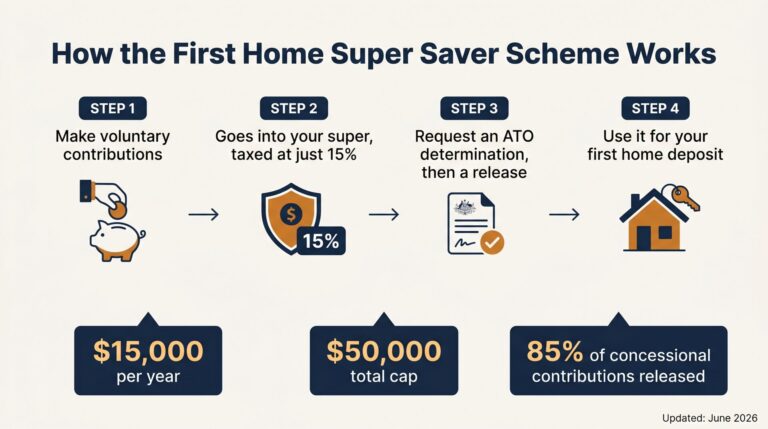
If you’re a first home buyer trying to figure out how big a deposit you need, work backwards from the LVR position you want, factor in stamp duty after any FHBAS concession, and add a buffer for off-the-plan valuation risk if that’s the property type you’re considering. A mortgage broker can model the trade-offs for your specific situation, including whether a government scheme can bridge the gap at 95% LVR without LMI. If you’re still building that deposit, the First Home Super Saver Scheme lets first home buyers save inside super at a lower tax rate.
This article contains general information only and does not constitute financial advice. Your personal financial situation, objectives and needs have not been considered. Before acting on any information, you should consider its appropriateness to your circumstances. Speak to a qualified mortgage broker for advice tailored to your situation. Mortgage World Australia Pty Ltd is a credit representative (CR No. 396946) of Mortgage Specialists Pty Ltd (Australian Credit Licence No. 387025).